

CASE STUDY
Developing Ideal Customer Personas to power Sales and Marketing.


The insight challenge
With B2B energy buyers harder to reach and increasingly served through brokers, SmartestEnergy needed an evidence-based view of the customers it should target and how to win them across both Commercial & Industrial and SME markets.
SmartestEnergy is one of the UK's largest independent suppliers of 100% renewable electricity to businesses, from single-site SMEs through to complex Commercial & Industrial (C&I) portfolios. In a market that defaults to price, their proposition is built on renewable credentials, contract flexibility, and generator-backed supply.
Sales, marketing and PR teams were each working with their own picture of the ‘right’ customer, making that proposition harder to land with the right buyers consistently.
The business needed a single, actionable view of its Ideal Customers and the buyers types making the decisions that sales, marketing, propositions and PR could all point to when making decisions.
“We are committed to enhancing our marketing and sales strategies through a deeper understanding of our target audience. We aim to develop comprehensive Ideal Customer Profiles (ICPs) and detailed buyer personas to inform personalised content creation and optimise our engagement approaches.”
The brief
Our solution

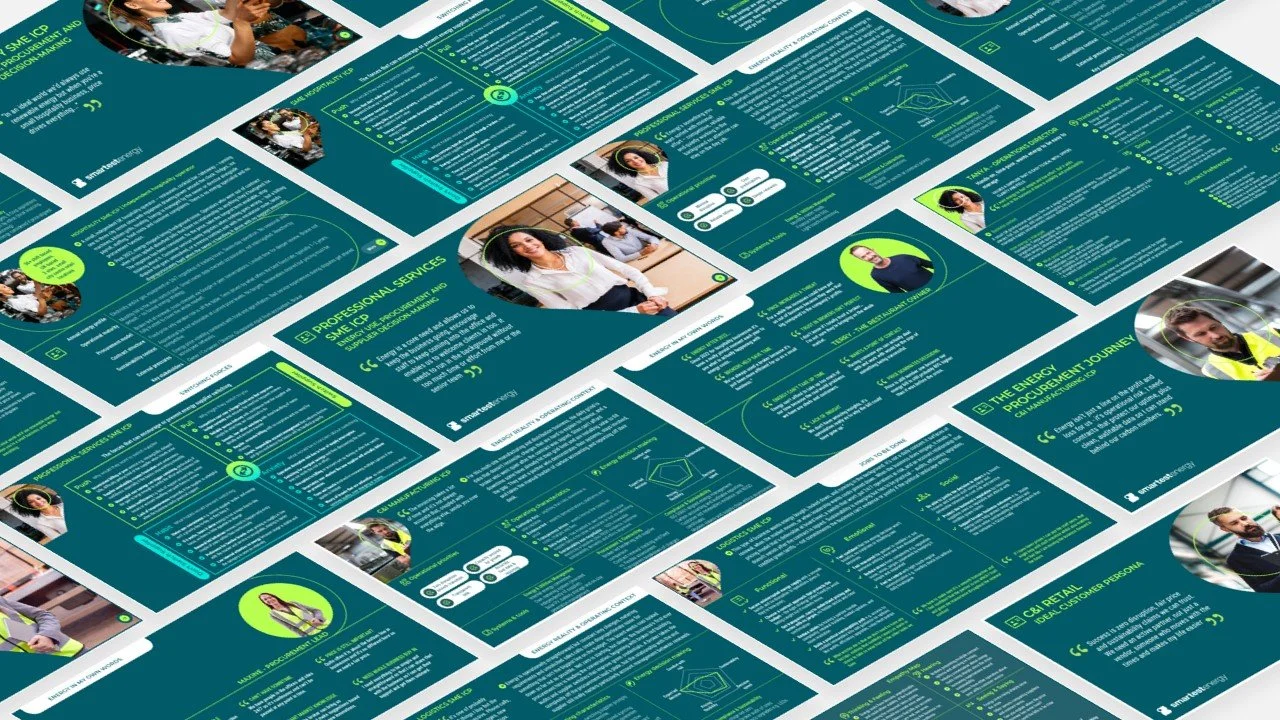
A two-phase research programme, quantitative first to size and profile the Ideal Customer Profiles, qualitative second to build Buyer Personas. These ran in parallel across both the Commercial & Industrial (C&I) and SME markets, and were delivered as an activation-ready toolkit on ICPs rather than a static report.
The whole programme was anchored in our application of the Switching Forces framework, mapping not just who the ideal buyer is, but why they would choose to switch energy supplier, or not.
Defining the Ideal Customer Profiles

Beginning with stakeholder outreach to define broad targets, we then conducted a quantitative survey of B2B energy decision-makers, split evenly across the C&I and SME markets and across both SmartestEnergy customers and non-customers, to identify and profile Ideal Customer Profiles.
Stakeholder engagement from the start
We started with Q&As with their marketing and sales teams to capture anecdotal patterns and assumptions behind what defines the ICP, plus a competitor review of positioning and messaging.
Switching mechanics
In addition to firmographics, buying cycles, committees and brand relationships, the survey captured what would push them away from their current supplier, what would pull them toward a new one, what anxieties would stall the decision, and what habits would keep them where they are.
Four audiences, one efficient design
A single c.15-minute survey reached four distinct groups SmartestEnergy customers and non-customers, across both C&I and SME with content tailored to each to ensure well-defined, commercially actionable profiles were developed
Aligned to customer profiles
Survey responses from existing customers were cross-referenced against SmartestEnergy's customer data to identify the sector, size and behavioural signatures most consistent with high-value, long-tenure accounts. This anchored the ICPs to commercial reality.
Building the Buyer Personas
A two-phase qualitative programme with buyers who mapped to the priority ICPs; a structured self-completion Q&A followed by a moderated video interview to turn each ICP into a rich set of Personas reflecting each of the key roles within the buying committee.
Detailed profiling
A detailed online mixed-method Q&A issued to decision makers prior to a moderated interview captured the foundations of each Persona: role, procurement model, current suppliers, priorities enabling the interview to focus on the forces that influence switching and brand choice in energy.
A suite of rich, multi-page Buyer Personas
Covering firmographics, psychographics, energy context, decision journey and the Switching Forces that shape each buyer's path to switching. Each was built on at least three interviews to avoid single-voice bias.
Empathy building interview
Moderated video conversations, tailored to each participant's profiling answers, to focus on understanding buying contexts and decisions: the triggers, the stakeholders in the room, and the objections that can land along the way to a closed deal.
Rooted in evidence
Every Persona could be traced back to a quantified ICP from phase one, so the qualitative depth never drifted from the commercial reality established by the survey.
Bringing the ICPs and Personas to life
Personas and ICP documents only work if the teams who need them actually reach for them. We shaped the deliverables around each team's real-world use case, with every claim traceable back to the underlying evidence.
Each c.10-page Persona covered firmographics, demographics and psychographics; a personality profile and behavioural biases; the buyer's energy context (current spend, supplier, usage patterns), the buying journey map and the strategic frameworks that make the Persona actionable including Jobs to be Done, Switching Forces, and Empathy Mapping.

For the Marketing and PR team, we distilled the same evidence into briefing decks tailored to journalist and analyst conversations the language buyers actually use, the market tensions they most feel, and the SmartestEnergy story elements that matter to each ICP's world.
Sales enablement workshops — engineered around the deal
For the sales team, we translated the Persona work into enablement decks structured around the account team's actual workflow: how to identify a prospect that fits an ICP, what to open the conversation with, how to handle the Anxieties and Habit-driven objections specific to that buyer type (different again for C&I versus SME), and which SmartestEnergy proof points land hardest against each Pull.
PR briefing decks — engineered around the story

Switching Forces. The framework at the heart of the programme
We anchored SmartestEnergy's ICPs in behaviour, using the Switching Forces framework to understand not just who the ideal buyer is, but what will most influence their buying decisions.
Switching Forces separates the four forces acting on any B2B buyer at any point in their decision, and treats each as an independent variable to be measured, mapped and messaged against.
PUSH
What's making the buyer dissatisfied with their current supplier or setup and the pressure that opens a switching window.
PULL
What draws them towards a specific new supplier and the value they can visualise and articulate.
ANXIETY
The friction, risk and uncertainty that hold them back from committing and the objections that get raised late in the sales cycle.
HABIT
The inertia and existing routines that keep the current arrangement in place, often a major and under-addressed force in B2B energy.
Outcomes

The programme gave SmartestEnergy a single, defensible articulation of its Ideal Customers, one that sales, marketing, propositions and PR now share.
The ICP deliverables were built as working tools, not static reports. Personas sit inside the sales team's day-to-day toolkit. Enablement decks drive target-account planning. PR briefings shape how SmartestEnergy tells its story externally. And because every deliverable traces back to one evidence base, quantified in phase one then humanised in phase two, teams that once worked from separate or ad hoc models of the customer now work from the same page, allowing the business units to work together to drive growth.