
CASE STUDY
Building an audience-centred framework to drive growth of a next generation TV platform.


The insight challenge
Everyone TV needed to understand what would make Freely the platform of choice for UK audiences both when buying a new TV / TV device and when choosing to watch in the home.
Everyone TV is backed by the UK's public service broadcasters (the BBC, ITV, Channel 4 and 5) and exists to make sure everyone can enjoy the best of British TV for free, however they're watching. Freely, launched in spring 2024, is its answer: the next generation of free TV, bringing live channels and on-demand together over an internet connection, without an aerial, dish or subscription.
Freely's growth challenge comes in two stages: first getting into homes, by being the platform people choose when they buy a new TV or TV device, then turning owners into active viewers once it's there, sitting alongside other services and established habits. Both come back to the same question: what would audiences value most from TV, so that they choose Freely and keep choosing it?
A toolkit of audience-centred insight and data was needed to provide a clear, shared view of which of the product opportunities that would create the most value for viewers, and therefore the greatest impact on adoption, engagement and long-term growth.
Our solution

Everyone TV needed more than a set of findings, they needed a durable, audience-centred framework and tool-kit to of insight to use for planning and decision making.
We designed a Jobs-to-be-Done research and insight programme spanning diary studies, a qualitative viewer insight-sprint, video interviews and a large-scale quantitative survey, built to uncover what audiences are really trying to achieve when they choose and use a TV platform. The insights would be developed into a toolkit Everyone TV could use as a foundation for an audience-centred approach to product and experience-led growth.
Discovering what audiences value most

JTBD starts from a simple idea: in this space, people don't choose a TV platform for its features, they choose it because it helps them get something done, e.g. ‘Easily find content that matches my current mood without causing frustration’. Uncovering those underlying Jobs gives a far more durable guide for decision-making based on value than testing individual features or content in isolation.
We began with a seven-day TV ‘switching diary’ across 40 households, capturing decisions, motivations and frustrations in the moment, from the sofa. This was followed by an online qualitative sprint with the same participants, where emerging themes were explored, refined and prioritised together with participants. Together, these stages surfaced around 150 distinct Jobs that shape viewing behaviour, which were then whittled down into 25 clearly defined bigger outcomes that audiences were seeking from free TV.
Understanding what matters most
With a long list of candidate Jobs in hand, the next step was working out which really mattered, and to whom.
Prioritising what matters
A survey of over 2,000 free TV viewers used trade-off modelling (MaxDiff) to quantify the relative importance of each Job, turning a long list into a clear, prioritised hierarchy the product team could act on.
Segmenting the market
Segmentation analysis identified distinct audience territories based on the Jobs people prioritise most, from those who above all want to stay connected and not miss out on what everyone's talking about, to those who simply want to get to great content, fast. Defining audiences by shared Jobs revealed real differences in motivation, openness to Freely and future growth potential.
Turning insight into action and empathy

Data alone doesn't change minds, so the final stage was about putting a human face on the findings and building them into the tools teams use every day.
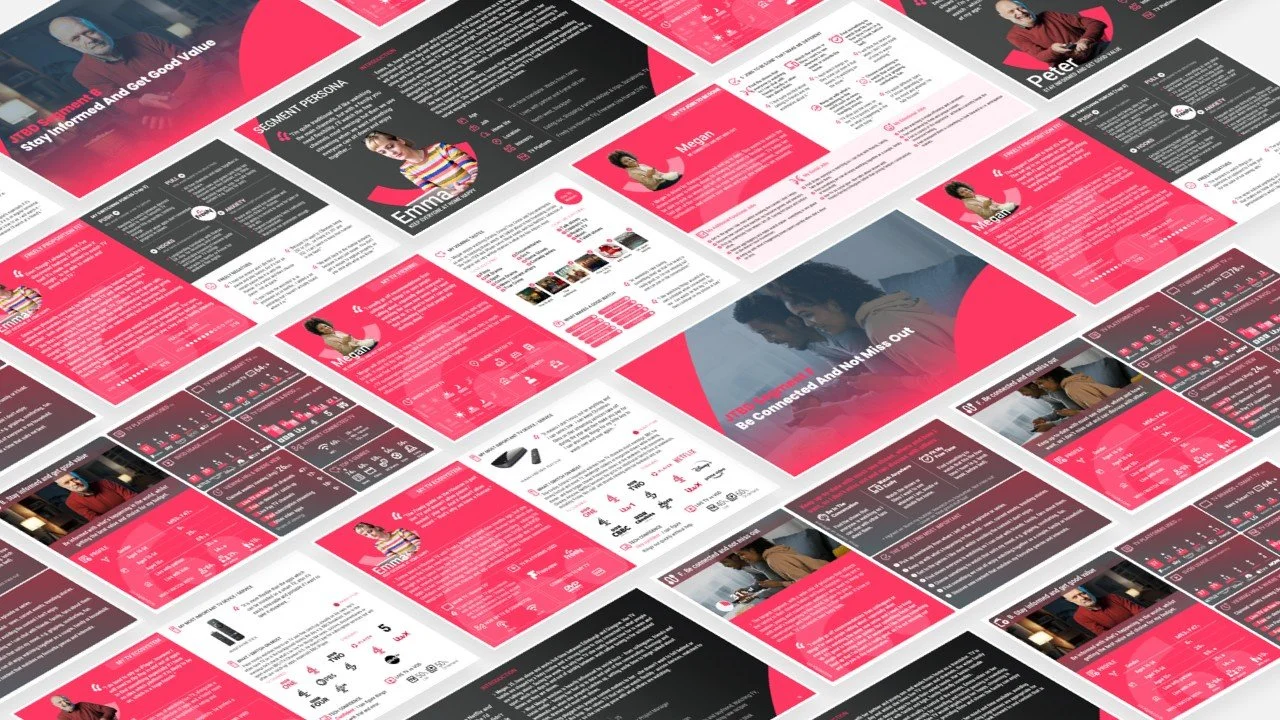
A series of video interviews with participants from earlier stages, each aligned to a segment's priority Jobs, added depth and real voices to the findings. These, together with the wider qualitative and quantitative research, were translated into empathy-rich JTBD Personas, one for each priority audience segment.
Each Persona brought its segment's shared Jobs to life through the real people behind them, covering their viewing behaviours (from typical viewing context to favourite genres and content), household and platform profile (tech set-up, devices and services in use), and the Switching Forces at play (the pains and gains shaping their relationship with Freely and other platforms). The result was a set of practical, memorable references teams could use to understand not just what each audience needs, but who they are.
The prioritised Jobs also provided the foundation for cross-functional Customer Journey Maps, embedding audience priorities end-to-end, from TV purchase through to everyday viewing.

Jobs-to-be-Done was central to our approach
A Job-to-be-Done is the underlying goal that shapes someone's needs and choices in a given situation. People "hire" the products and brands that help them get a Job done well, and drop or don't choose the ones that don't.
Most brands look inward, asking what their product needs to compete. JTBD flips this, starting with people: what are they trying to accomplish, and how can we help them succeed? The Job, not the product, defines the real market. For example, ‘streaming TV’ is a product category, whilst ‘easily find something great to watch without hassle or extra costs’ is a Job to be Done, and it endures while the solutions around it keep changing.
Jobs to be Done operate at different levels, and each one guides a different kind of decision:
Aspirational
For people: The bigger ambition I'm ultimately trying to fulfil, e.g. "Make the most of my free time and budget with content I can easily find and enjoy."
For brands: Defines the real category and territory you operate in (and your competition).
Big
For people: The main goals I'm working towards along the way, e.g. “Easily find content that matches my current mood without causing frustration.”
For brands: The principal opportunities for growth and differentiation.
Emotional & social
For people: How I want to feel (e.g. “Create moments of peace.”), and how I want to be seen (“e.g. Be the friend with great taste.”)
For brands: Shapes content, messaging and brand experience.
Functional
For people: Specific, actionable needs, e.g. “Easily save and recall content that looks good to watch at a later time.”
For brands: highlight opportunities for product features, service enhancements.
Outcomes

The programme gave Everyone TV a shared, audience-led decision framework, not a static report, aligning product, UX and CX teams around a common definition of value and a common language of Jobs, needs and Switching Forces.
The research consistently pointed to a small number of Jobs which has informed real product decisions, from new features to development of added functionality to code features like the TV Guide. All designed around how people actually search for something to watch.
Beyond individual features, JTBD has been embedded into roadmap planning and governance, so new initiatives are assessed against audience impact rather than instinct, and into wider measurement, including customer satisfaction tracking, so that success is judged against the outcomes audiences value most. It's also strengthened conversations with manufacturers and strategic partners, giving Everyone TV an evidence-based way to articulate audience demand.
“The Jobs-to-be-Done research Waveform delivered has enabled us to ensure audiences are at the centre of Freely's product growth strategy. It has given us a clear, prioritised view of what viewers value most and has become a lens through which we consider product and feature decisions.”