

CASE STUDY
Informing a needs-led charitable strategy using Jobs-to-be-Done audience segmentation.


The insight challenge
GroceryAid was seeking to grow the reach and impact of the support it provided grocery workers in need by developing a fresh needs-led approach.
GroceryAid is the industry charity supporting workers across the UK grocery sector, offering emotional, financial and practical help to anyone in the trade. But like many charities, awareness and take-up lagged behind need: many grocery workers facing tough times either didn't know support existed or didn't engage with what was on offer.
The challenge went beyond a communications fix. GroceryAid needed a deep, evidenced understanding of the needs, crisis journeys and barriers to help-seeking among grocery workers, translated into a segmentation that could directly shape communications, UX and outreach strategy, on a budget appropriate for a charitable organisation.
“The Waveform team took a pretty comprehensive brief, then showed us how they could deliver not only that but so much more, all within a budget that we, as a charitable organisation, could actually afford.”
Insight Manager, Grocery Aid
Our solution

A three-phase mixed-method programme, moving from lived experience to validated priorities to an activation-ready segmentation.
We designed a research programme that started with the people closest to the problem (GroceryAid's own frontline staff), moved through the lived experience of grocery workers themselves, then validated and prioritised what we'd learned at scale.
Uncovering the audience needs

We didn't start with GroceryAid's existing service categories. We started with what grocery workers were actually trying to achieve when life got hard.
Frontline knowledge first
A video Q&A programme with GroceryAid's own counsellors and caseworkers surfaced common crisis triggers, audience types and gaps in the current support journey, grounding the research in real casework from day one.
A safe place to discuss needs in a crisis
An online qualitative community with grocery workers across retail, logistics, wholesale and FMCG explored lived experience, help-seeking behaviour and reactions to GroceryAid's existing proposition and communications. An inclusive approach that provided a safe space for discussing sensitive subjects, the online qualitative approach generated many hours of participation and surfaced hundreds of individual Jobs-to-be-Done whilst exploring support needs and journeys in depth.
Shortlisting the needs that matter
We distilled this down to 23 priority Jobs-to-be-Done, spanning five outcome territories: affording the day-to-day, regaining control and stability, improving health and wellbeing, feeling understood and supported, and getting practical help to act.
Prioritising and segmenting at scale

Knowing a need exists isn't the same as knowing how much it matters. We used a robust quantitative survey to find out.
Validating at scale
A large-scale survey of grocery workers who'd faced tough times in the recent past used MaxDiff prioritisation to test and rank the shortlisted Jobs-to-be-Done, revealing clear differences in relative importance across the audience.
Identifying distinct audience needs states
Cluster analysis grouped grocery workers into distinct need-based segments, each defined by a different combination of priority needs, from those wanting structured, judgement-free support to get back on track, to those in acute crisis needing immediate, human help.
Understanding what drives and blocks action
Using a Switching Forces framework, we identified the Push, Pull, Habit and Anxiety factors shaping whether grocery workers seek help at all, and what would make them more likely to choose GroceryAid specifically over waiting, coping alone, or going elsewhere.
Turning insight into a usable toolkit

Segments only earn their keep if teams can act on them. So alongside the segmentation, we tested how GroceryAid's own website and journeys actually perform.
Journey testing, not just survey data
We asked grocery workers to walk through GroceryAid's financial, emotional and practical support journeys live, screen-recording their experience of the site, including the financial grant application form and confirmation email.
Rich segment personas
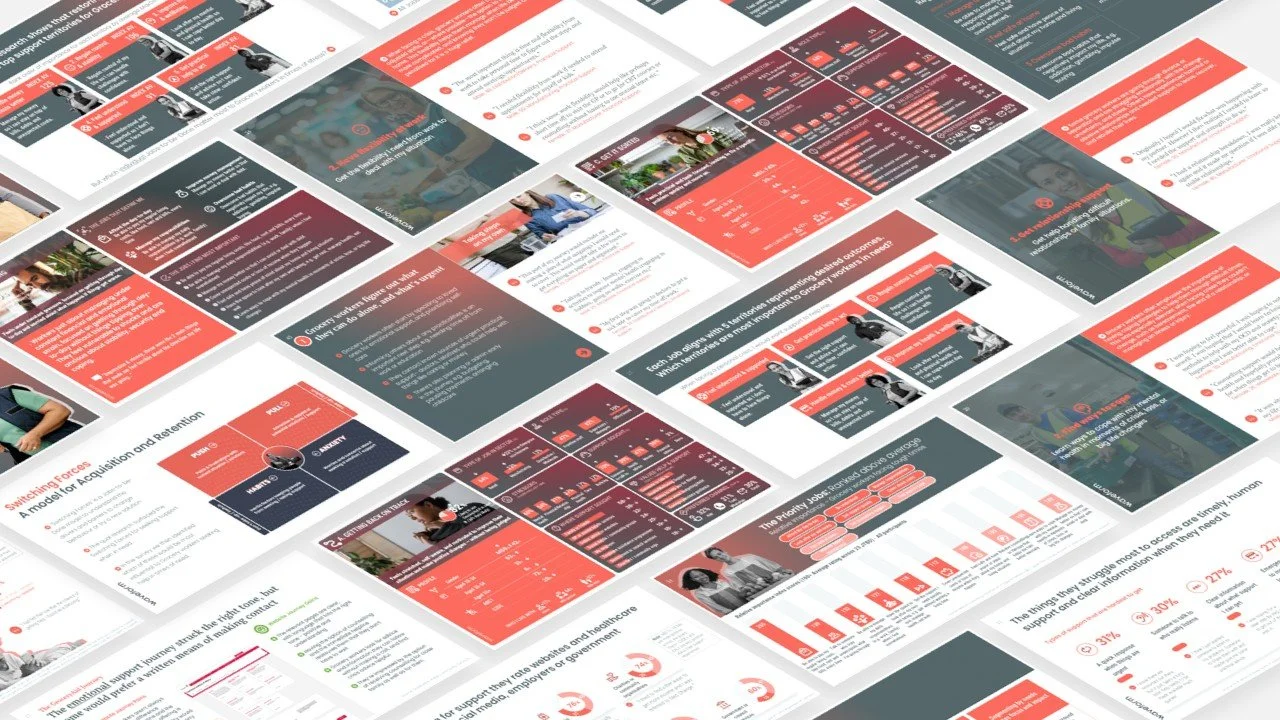
Each segment was profiled with a pen portrait covering its priority Jobs-to-be-Done, broad demographic skew, preferred contact channels and the specific drivers and barriers that apply to it, giving GroceryAid a practical reference for targeting and messaging.
From data to a foundation for action
The outputs give GroceryAid a strategic foundation it didn't have before: a validated view of what matters most, to whom, and how to reach each group in the way they'd actually respond to.

Jobs-to-be-Done was central to our approach
A Job-to-be-Done is the underlying goal that shapes someone's needs and choices in a given situation. People turn to the products and organisations that help them get a Job done well, and drop or don't choose the ones that don't.
Most organisations look inward, asking what their service needs to offer. JTBD flips this, starting with people: what are they trying to accomplish, and how can we help them succeed? The Job, not the service, defines what really matters. For example, "Charity support" is a category, whilst "Feel back in control of my life when things fall apart" is a Job to be Done, and it endures whatever form the support takes, from a phone helpline, to a financial grant, to a signposted charity partner.
Jobs to be Done operate at different levels, and each one guides a different kind of decision:
Aspirational
For people: The bigger ambition I'm ultimately trying to fulfil, e.g. "Get through a difficult period and come out the other side more secure."
For brands: Defines the real category and territory you operate in (and your competition, from informal support to statutory services).
Big
For people: The main goals I'm working towards along the way, e.g. "Get financial help quickly enough that it actually prevents a crisis, not just responds to one."
For brands: The principal opportunities for growth and differentiation.
Emotional & social
For people: How I want to feel (e.g. "Feel less alone with this."), and how I want to be seen ("e.g. Be seen as coping, not as someone in crisis.")
For brands: Shapes content, messaging and brand experience.
Functional
For people: Specific, actionable needs, e.g. "Easily find out if I'm eligible for support without a long form or a phone call."
For brands: Highlights opportunities for service design, digital journeys and access points.
Outcomes

A needs-based segmentation and suite of rich audience personas, providing a strategic foundation for communications, UX and outreach.
The research gave GroceryAid an evidence base covering Jobs-to-be-Done, Switching Forces, journey preferences and fit with GroceryAid's existing proposition for each segment. It's already being used to help size the opportunity, reshape the proposition, restructure the website, and inform GroceryAid's evolving comms and media strategy.
“Waveform have provided us with a rich seam of insights which we are using to help size our opportunity, reshape our proposition, restructure our website, and which will be fed into our evolving comms and media strategies… their deliverables were enlightening, impactful and actionable.”
Insight Manager, Grocery Aid