From artefact to action: using Jobs to be Done and Switching Forces to enhance journey maps
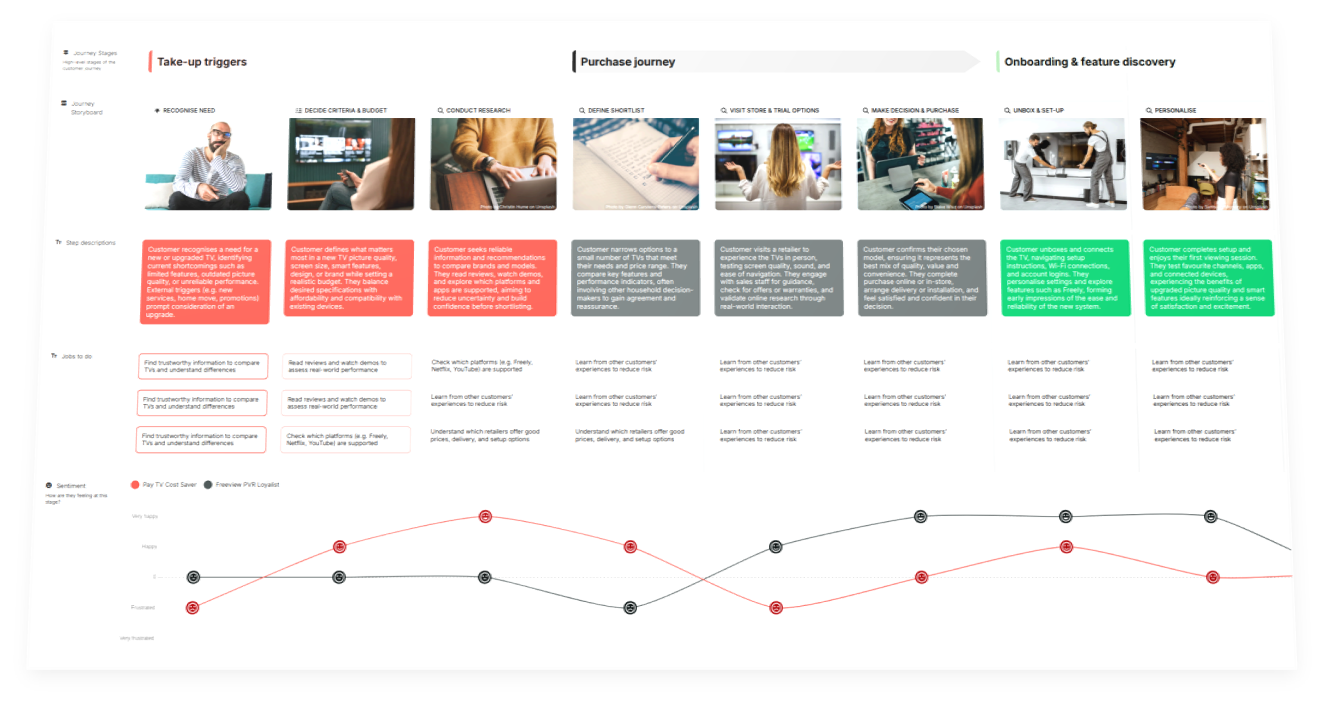
Most journey maps end up admired in a workshop and then quietly forgotten. The problem is rarely the effort that went in, it is that the map shows what people do without explaining why. Here is how building maps on Jobs to be Done and Switching Forces turns a static artefact into a working tool teams actually use, drawing on a recent project for a mass market TV platform.
If you have ever spent weeks on a journey map only to watch it end up admired in a workshop, pinned to a wall, and then quietly forgotten, you are not alone. It is one of the most common frustrations we hear. And the issue is rarely the effort that went in. More often, the map captures what people do without quite getting to why they do it, or what might lead them to do something different.
That gap is the thing worth closing. The shift we find most useful is to stop thinking of a journey map as a record of steps and start treating it as a model of motivation. Two frameworks make that possible: Jobs to be Done (JTBD) and Switching Forces. We recently used both to build an experience map for a mass market TV platform, and the difference in how the work landed, and how it got used afterwards, was striking. Here is why.
The limits of a conventional journey map
A standard journey map plots the stages a person moves through, the touchpoints they hit, and how they feel along the way. That is genuinely useful. It builds shared understanding across a team and surfaces the obvious moments of friction.
But it can stall at description. It might tell you a user felt frustrated at setup, or dropped off during onboarding, without telling you what they were actually trying to accomplish, what drew them to your product in the first place, or what quietly tugged them back to the old way of doing things. You are left with symptoms but no diagnosis. Teams end up guessing at fixes, and the map slowly becomes a reference document rather than something that helps you decide anything.
What Jobs to be Done adds
JTBD reframes every stage around the outcome a person is trying to achieve, in their terms rather than yours. Not ‘user navigates the setup wizard’ but ‘get to a working, watchable state as quickly as possible, without needing help or getting frustrated.’
It sounds like a small change in wording. In practice it changes what the map is for. When each step carries the job beneath it, a few good things happen.
First, the map becomes genuinely human-centred. You are no longer watching your product move through its own funnel. You are watching a person trying to get something done, with your product as one part of that. This tends to build the kind of real empathy in a team that survives contact with a roadmap prioritisation meeting.
Second, it separates the durable from the incidental. Jobs are stable. The specific feature someone reaches for changes all the time, but the underlying job rarely does. Anchoring the map to jobs keeps it relevant even as the interface, the technology, or the competitive set moves on.
Third, it makes the map actionable. A job is something you can design against. “Help the user reach first successful viewing without friction” tells a product team what good looks like. “User feels confused” does not.
What Switching Forces adds
If JTBD tells you what people are trying to achieve, Switching Forces tells you why they move, or fail to move, from one solution to another. The framework, developed by Bob Moesta and the Rewired Group and sometimes called the Four Forces of Progress, looks at four forces acting on any decision: the push of the current situation, the pull of the new option, the anxiety about that new option, and the habit and inertia holding people where they are.
Laying this over a journey map is where things get interesting. At each step you can ask not just “what is the user doing” but “what forces are in play, and which way are they pointing.” A moment that looks perfectly neutral on a conventional map often turns out to be a quiet tug of war between the pull of a new feature and the comfort of an old habit.
On the TV platform work, this lens kept surfacing moments where the deciding factor was not whether the product was good, but whether habit pulled the user back to a familiar route before the new option had a fair chance to prove itself. Those are exactly the moments worth focusing on, and a standard map would have shown them as unremarkable.
The forces framing also changes how you think about friction. Anxiety and inertia are not failures on the user’s part. They are predictable, and you can design to reduce them. That quietly turns a list of complaints into a list of opportunities.
What it looks like in combination
Put the two together and a flat map gains real depth. Each step now answers a richer set of questions. What is this person trying to get done? What is pulling them toward us, and pushing them away from the alternative? What anxiety or habit is working against that? And so, where should we focus, and what would a meaningful intervention actually look like here?
The result reads less like a diary of an experience and more like a strategic brief. Stakeholders can see where the highest-leverage moments sit, why they matter, and what is at stake if they are left alone. For the TV platform, it became clear that a handful of early moments carried far more weight than their size suggested in shaping long-term behaviour, and that several of the biggest risks were behavioural rather than technical. That is a much more useful place to start a roadmap than a heatmap of sad faces.
Why this matters for getting things done
The honest test of any journey map is whether it changes a decision. A beautiful artefact that no one acts on has not really worked, however good it looks on the wall.
Building on JTBD and Switching Forces tilts the odds toward action, because the map arrives with the why already built in. It does not just point at where the experience falls short. It explains the mechanism behind the shortfall, which makes the fix easier to spot and easier to justify. It gives product, marketing and CX teams a shared language for talking about the same moments. And because it rests on durable jobs rather than the current interface, it keeps earning its place long after the first workshop.
A journey map should be a working tool, not a wall decoration. Grounding it in what people are trying to achieve, and the forces that move them, is the most reliable way we have found to make that happen.
If you would like to talk through how this approach might work for your own customer journey, we would be glad to share more about how we go about it. Get in touch.