
A practical guide to commissioning market research
A Research Buyer’s Guide

Most people commissioning research are not starting with a blank sheet. There is usually a decision coming up: a value proposition to launch, a target audience to understand, a go-to-market plan to set, a retention problem to solve, or a new strategy that needs stronger evidence behind it.
Research can play an invaluable role in driving each of these and more. The challenge is working out what you really need to know, how to ensure you can have confidence in what you discover and the best way to get there.
This guide brings together some of what the Waveform Insight team has learnt from more than 20 years both commissioning and delivering research. It covers the practical questions we are asked most often, from choosing an approach and setting a budget to briefing a partner and deciding how much support you actually need.
By Waveform Insight · Updated November 2026
A Research Buyer’s Guide - At a glance
Typical cost: £10,000 to £60,000+ for a full-service UK project
Typical timing: 2 to 12 weeks, depending on audience and method
Support options: self-serve, fieldwork-only or full-service
Where to start: the decision the research needs to support
Don’t forget: existing data, involving stakeholders early and planning deliverables from the start
When should you commission market research?
Market research tends to add most value at one of three moments: when you are creating something new, preparing to launch, or looking for the next phase of growth. The specific questions vary enormously, but here are some typical strategic questions research can help answer.

Create
What should we build or develop?
Which customer needs and opportunities are underserved?
Which audiences should we prioritise?
What would make our proposition genuinely valuable?
Launch
Is there a market for our proposition, and how could it be improved?
How should we position and communicate the offer?
What should we charge, and should we offer different tiers?
Which propositions, features or messages are most compelling?
Grow
How is our brand performing against competitors and customer expectations?
What is working, and where is the customer experience falling short?
Why are customers leaving, and what would make them stay?
How can we improve acquisition, engagement and loyalty?
Whatever the question, the principles for commissioning research well are broadly the same. The guide below takes you through them.
What this guide covers
Our guide covers 11 steps to help you commission a successful research project and get more value from the investment.
1. Business objectives: What decisions and initiatives does your research need to support?
2. Background: What do you already know: research and data you already have to build on?
3. Project objectives: What does a successful research project look like?
4. Deliverables: How do you make sure research lands and delivers impact?
5. Solution: Self-serve, fieldwork-only or full-service research?
6. Synthetic: Is synthetic research a viable option, and what are the risks?
8. Project timings: How long does a market research project take?
9. The brief: What should you include in a market research brief?
10. Commission: How do you choose the right research agency or consultancy?
11. Delivery: How do you get the most value from a research project and keep it on track?


1. Business objectives: What decisions and initiatives does your research need to support?
Every research project should start with the business decision it needs to inform, rather than the method used to answer it.
Before deciding whether to run qualitative research, quantitative research or a mix of the two, the more important questions are:
What business decisions and initiatives will this research inform?
What do we need to understand to make that decision well or improve initiatives?
Sometimes the question is big: which audiences should we prioritise over the next five years, or where should our next phase of growth come from? Sometimes it is much more focused: which of two propositions is more compelling, what should we charge, or why are customers cancelling?
All are questions where research can add value, but the evidence, approach, budget and time needed to answer them can be very different. This is where an experienced research partner can add real value. The solutions and research methods recommended should be bespoke to those business questions, and often different from those a client first has in mind. For example:
Video diaries and interviews can reveal far more about a real decision-making journey than focus groups.
The audience originally earmarked for a survey might exclude an important growth opportunity.
Existing customer data combined with a smaller piece of primary research might answer the insight needs better than a large new study.
The role of a good research partner is to work backwards from the decision and design the most effective way of getting to the evidence you need. That means considering the research question alongside the wider context, including what is already known, the importance of the decision, the stakeholders for the research, the time available and the budget.
From our experience, the best research projects have clearly defined outcomes for which we design approaches that provide the clarity and confidence to make a better decision. And often, we’ll learn something surprising along the way that can be transformative.
Once you are clear about the decision, the next question is what evidence you already have to help answer it.


2. Background: What do you already know: research and data you already have to build on?
Reviewing existing evidence first means new research can focus on the gaps, rather than covering ground the business already understands. Start by taking stock of what is already available before launching a new project.
This might include:
Previous research
Customer and CRM data
Website or product analytics
Sales data
Customer feedback
Behavioural data
Knowledge held within teams across the business
This evidence can change the shape of the project. It might show that some questions have already been answered, expose gaps that need more attention or highlight audiences and opportunities that were not part of the original brief.
Imagine you are trying to reduce customer churn. Your behavioural data may already tell you who is leaving and when. Research can then focus on what the data cannot tell you: what changed, what alternatives customers considered and what might have persuaded them to stay. In some cases, it can reduce the amount of new research required. In others, combining existing evidence with fresh research can produce a much richer picture than either would provide alone.
A good insight partner can help with this process too. We have worked with clients to review and synthesise existing research and customer data before recommending what new evidence is needed.
This is one of the differences between an insight consultancy and a research provider. Rather than simply delivering a defined study, the role is to step back, understand the wider decision and work out how existing evidence and new research can best come together to answer it.
With that existing evidence on the table, you can be much more precise about what is still missing.


3. Project objectives: What does a successful research project look like?
A successful research project is designed around clear questions, the decisions it will inform and the outputs needed at the end, rather than a predetermined method.
Different objectives naturally lead to different kinds of research:
Understanding how customers think, behave or make decisions may call for qualitative research.
Making major decisions around pricing, positioning or market opportunity may require robust quantitative evidence and advanced analytics.
Audience strategy, segmentation and proposition development will often require a combination of approaches.
The most useful brief therefore focuses on what you need to know and how the findings will be used. Consider:
Which audiences do you need to understand?
What decisions need to be made?
How much confidence is required in the findings?
What data or outputs will different teams need?
Who will ultimately use the research?
Does the work need to inform an existing framework, such as Jobs to be Done?
From there, an experienced research partner should be able to recommend the most appropriate approach and explain why. The methods available to researchers continue to evolve too. Focus groups were once the default for many qualitative projects. Today, approaches such as mobile ethnography, video diaries, online communities and behavioural methods can often provide a richer view of what people actually do and how decisions are made.
If the decision is which audiences to prioritise for future growth, you may need more than an interesting set of personas. You may need to know how large each audience is, its potential value and how reliably people can be identified and reached.
The methodology is a means to an end. The important thing is that the approach reflects the question, the context and the way the findings will ultimately be used.
Once you are clear about what success looks like, it is worth thinking about how the findings will need to be used. The outputs are part of the research design, not just the packaging at the end.

4. Deliverables: How do you make sure research lands and delivers impact?
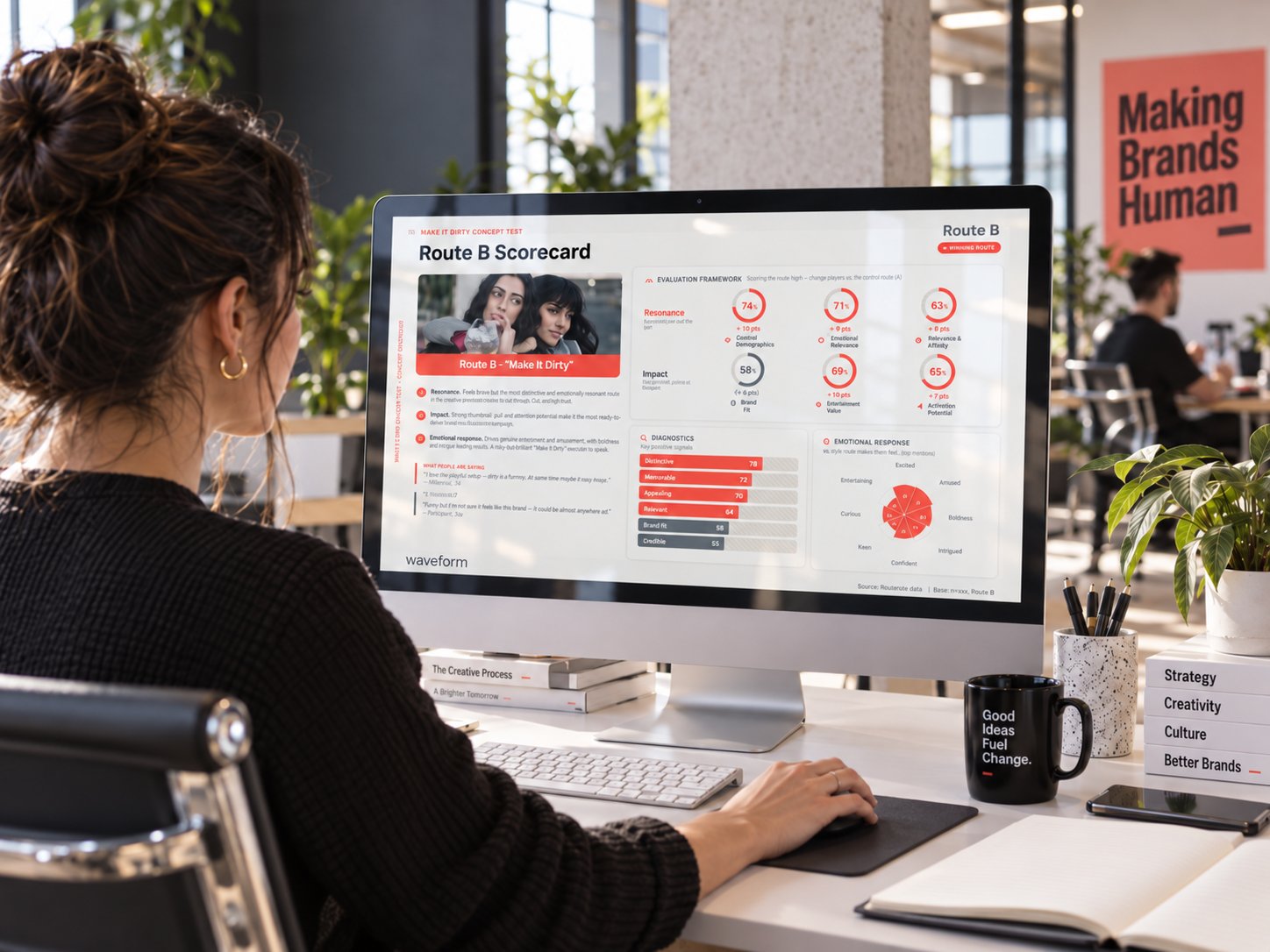
Research has most impact when the outputs are designed around the people who need to use it and planned as part of the project, not added at the end. Considering the deliverables you need upfront can have a big impact on how the research is designed and how it lands.
The value of research does not just come from the quality of the findings. How those findings are delivered can have a big impact on whether people understand them, remember them and act on them.
A PowerPoint report and stakeholder debrief are still the norm for many projects, and often they are exactly what is needed. But there are many other options worth considering, particularly when the research needs to influence a wider group of people or support decisions over time.
Different outputs can serve different purposes:
Build customer closeness: Edited participant videos, audio clips, customer stories and showreels can make audiences feel real and memorable, helping stakeholders connect emotionally with the people behind the data.
Create practical tools: Some outputs are designed to help teams apply the research directly. These might include customer journey maps, personas, conjoint simulators, segmentation algorithms, allocation tools or decision frameworks.
Help teams take action: Workshops and working sessions can turn findings into decisions, priorities and next steps. Depending on the project, this might involve prioritising opportunities, refining propositions, agreeing target audiences or translating insight into a roadmap.
Share the research more widely: Microsites, posters, research walls, printed summaries, internal newsletters, lunch and learn sessions and other accessible formats can help the insight travel beyond the core project team.
This is also an area where a full-service research partner can add significant value. They should be thinking not only about how to answer the research questions, but how to turn the evidence into something that creates impact across the organisation.
With the outcomes and deliverables clear, you can then decide how much of the research you want to manage internally and where external expertise will add most value.


5. Solution: Self-serve, fieldwork-only or full-service research?
Route 1: Self-serve
For relatively straightforward questions, self-serve tools can be a fast and cost effective option. Platforms such as SurveyMonkey, Typeform and Qualtrics allow teams to build surveys, collect responses and analyse results themselves.
Qualitative research is becoming more accessible too, with newer tools able to conduct AI-moderated interviews with real participants and ask follow-up questions based on their responses.
These tools can be extremely useful, particularly when you have research expertise internally. But making research easy to run does not necessarily make it easy to design.
A survey question can look perfectly reasonable while introducing bias or producing data that is difficult to interpret. Common pitfalls include:
Leading or ambiguous wording
Unbalanced response scales
Missing or overlapping answer options
Poor question order
Routing that unintentionally excludes people
Asking about hypothetical intention rather than recent behaviour
Questionnaires that work poorly on mobile
Sampling is another area where self serve research can become more complicated than it first appears. You need to make sure the people taking part genuinely represent the audience you want to understand, that they come from reliable sources, and that quotas and sample design are appropriate. Online research also faces growing challenges from fraud, bots, duplicate respondents and people rushing through surveys simply to collect incentives. Experienced research providers have processes for checking participant quality and cleaning the data before analysis. Routes 2 and 3 can therefore remove a significant part of this headache by putting recruitment, sampling and data quality in the hands of specialists.
Those details matter because the cost of poor research is rarely the survey itself. It is the decision made on the back of unreliable evidence.
Route 2: Fieldwork only
A middle ground is to retain the research design, analysis and reporting internally, while using a specialist partner to manage the fieldwork.
Your team might develop the questionnaire or discussion guide and define the audience, while the partner manages:
Participant recruitment
Sample management
Survey programming
Interviewing or moderation
Data collection
This can work particularly well for experienced insight teams that have the expertise to design and interpret the research but need additional capacity, access to specialist audiences or robust fieldwork infrastructure.
Route 3: Full-service
For more complex or strategically important questions, a full-service research consultancy can manage the project from defining the research approach through to analysis, recommendations and stakeholder delivery.
The additional value is not simply taking work off your hands. A good research partner should:
Challenge the brief
Recommend the most appropriate methods
Identify gaps or opportunities that may not have been considered
Bring relevant experience from similar questions and audiences
Connect the findings back to the decisions the organisation needs to make
This tends to matter most where the question is ambiguous, the audience is difficult to reach, several sources of evidence need to be combined, advanced analysis is required, or the research will inform a significant investment or strategic decision.
If millions are being invested in a new service, simply knowing that people “like the idea” is rarely enough. You may need to understand which elements create value, what competes for the same need, how much people will pay and what would actually prompt them to switch.
Ultimately, the choice is not simply between doing research yourself or using an agency. It is about deciding where external expertise will add enough value to justify the investment.
Whichever route you choose, there is now another option to consider: where, if anywhere, synthetic research and personas can play a useful role in the research itself.
Self-serve tools suit simpler questions, fieldwork-only support suits experienced insight teams that need extra capacity, and full-service research suits complex questions or decisions with a lot riding on them.
The right route for your project depends on three things:
The complexity of the question
The expertise and capacity within your team
How much is riding on the decision


6. Is synthetic research a viable option, and what are the risks?
Synthetic research can help with early, well-defined evaluative tasks and desk research, but we do not see it as a viable alternative to real people for truly exploratory or strategic work.
Synthetic participants use AI to simulate how particular audiences might think, feel or behave. They are different from AI tools that help analyse research or moderate interviews with real people, where the evidence still comes from human participants.
Used carefully, synthetic participants can have value. They can help:
Generate hypotheses
Identify possible reactions and attitudes
Stress test questionnaires or discussion guides
Screen early ideas before investing in primary research
Support some types of evaluative work where the questions are well defined
We wouldn’t recommend synthetic participants for exploratory or strategic work, or where a decision carries real weight. Current evidence suggests synthetic data skews positive and clusters around the average, missing the full range of views that research with real people captures.
The value of speaking to real people is not simply getting an accurate answer. It is developing empathy and understanding how needs, choices and behaviours fit into the complexity of people's real lives.
It is often the unexpected comment, workaround, frustration or niche behaviour that challenges assumptions and reveals an opportunity nobody was looking for. Real participant stories can also bring findings to life for stakeholders and create the conviction to act on them.
Read our perspective on synthetic research and human understanding.
Once the scope and level of support become clearer, the conversation usually moves pretty quickly to money.


7. Budget: How much does a market research project cost?
A full-service UK research project typically costs from around £10,000-£15,000 for a focused study to £60,000 or more for a mixed-method segmentation, with typical examples in the table below.
Research budgets are rarely unlimited. Sometimes research has been planned and budgeted for from the outset. Just as often, a new question or opportunity emerges and the budget has to be found from somewhere else.
Quality research is not cheap, particularly when you need to reach specialist audiences, speak to large numbers of people or carry out complex analysis. But in our experience, research costs have not risen in the way many other business costs have. If anything, a like-for-like project can often be delivered more cost effectively today than it could ten years ago.
The biggest cost drivers are usually:
Who you need to speak to
How many people you need to reach
How easy or difficult they are to recruit
The research methods being used
The number of markets involved
The complexity of the analysis
The level of consultancy and stakeholder support required
This is another reason to start with the decision and the evidence you need, rather than a predetermined method. A good research partner should be able to design an approach around both the question and the budget.
That might mean:
Narrowing the scope
Using existing data alongside new research
Adjusting the sample
Combining methods differently
Focusing investment on the areas where it will most improve the quality of the decision
It is also worth viewing the research budget in the context of the decision it supports. A £20,000 research project may sound substantial in isolation, but much less so if it is informing a multimillion pound product launch, a major pricing decision or a new customer strategy.
We would always encourage clients to be open about budget. Knowing what is available makes it easier to recommend the strongest approach within it, rather than designing the ideal project and then having to scale it back later. It can also be useful to ask for different options. We are often asked to provide Gold, Silver and Bronze approaches, clearly setting out the additional value and trade-offs at each level. That allows the client to decide where they believe the extra investment will have most impact.
What might a full-service research project cost?
The examples below are intended as a guide rather than a rate card. All assume a full-service project, including research design and consultancy, participant recruitment or survey sample, fieldwork, analysis, reporting and a debrief with stakeholders.
| Type of research | Example project | Typical guide price |
|---|---|---|
| Qualitative, focused | 10 to 15 customer or user interviews exploring needs, behaviours, decision journeys or reactions to a proposition | £10,000 to £15,000 |
| Qualitative, in-depth | A diary study or online research community following 20-30 people over several days to understand behaviours, journeys and experiences in context | £15,000 to £25,000 |
| Quantitative, focused | A 10-minute nationally representative survey of around 1,000 UK adults, for example to test a proposition, concept or message | £10,000 to £12,000 |
| Quantitative, strategic | A survey of a defined target audience to inform pricing, positioning or proposition strategy, including techniques such as conjoint, MaxDiff or pricing analytics | £15,000 to £25,000 |
| Mixed methods, audience understanding | Exploratory project, including qualitative research and follow-up survey to understand a market, customer needs, behaviours and opportunities | £25,000 to £35,000 |
| Mixed methods, segmentation | Qualitative exploration followed by a robust quantitative segmentation, segment profiling and development of actionable personas and segment model | £40,000 to £60,000+ |
These costs can move significantly depending on the audience and scope. Research with a broad UK consumer audience will usually cost less than reaching a niche group of customers, senior business decision-makers or people across several international markets. The outputs can also have a notable impact on costs, with a PowerPoint report and debrief being the base cost that can then be supplemented with everything from video personas to interactive dashboards and analytical models.
There are also plenty of ways to adapt a project to the budget available. The important question is where investment will have the greatest impact on the quality of the evidence and the decision it needs to support.
If cost is usually the first practical question, timing is rarely far behind.


8. Project timings: How long does a market research project take?
Most market research projects take between 3 to 12 weeks, from a 2 to 3 week survey to a 10 to 12 week segmentation study that involves both qualitative and quantitative research plus complex analytics.
Timings depend on the audience, methodology and complexity of the project, but most research can move faster than many people expect. Projects running beyond three months are now rare, and usually reserved for the largest strategic programmes.
A focused project can often be completed in a few weeks. Larger strategic programmes, particularly those involving multiple stages, specialist audiences or advanced analysis, will naturally take longer.
Below is a rough guide of what to expect. Projects tend to run longer when client teams need more time to review and feed in, or when stakeholder diaries are hard to pin down.
| Type of project | Typical timeframe |
|---|---|
| 10 to 15 depth interviews | 3 to 4 weeks |
| Diary study or online research community | 4 to 5 weeks |
| 10-minute nationally representative survey | 2 to 3 weeks |
| Pricing, positioning or proposition survey | 4 to 5 weeks |
| Mixed method, audience understanding study | 5 to 7 weeks |
| Mixed method segmentation study | 10 to 12 weeks |
The main stages usually include research design, recruitment or survey programming, fieldwork, analysis and reporting. Specialist recruitment, international research, complex stimulus development or additional stakeholder input can all add time.
There are often ways to work faster when a decision needs to be made quickly. Research phases can be run in parallel, outputs can be staged, or a focused first phase can answer the most urgent question while deeper work continues.
What matters is being clear about the decision deadline from the start. A good research partner can then design the project around it and be upfront about where speed is possible, and where cutting time would start to compromise the quality of the evidence.
With a clearer idea of the outcome, budget and timing, the next step is communicating the challenge to potential research partners.


9. The brief: What should you include in a market research brief?
A useful market research brief explains the background, the decision the research will inform, what you need to understand, the audience, timing and budget, and how the findings will be used.
A written brief is useful, particularly when several stakeholders need to align on what the research needs to achieve. But it is not essential. If time is short or you need to get a project moving quickly, a good research partner should be able to take the brief through a conversation.
We often start with a client meeting to understand the background, business challenge, objectives and constraints. We then reflect this back in our proposal, setting out our understanding of the brief alongside the research approach we recommend. This gives the client an opportunity to review and refine the objectives before the project begins.
Whether you write a formal brief or talk it through, the important thing is to give your research partner enough context to understand what you are trying to achieve. At a minimum, try to cover:
The background: What is happening in the business and why has the need for research arisen?
The decision: What will the research help you decide, develop or change?
What you need to understand: What are the key questions you need the research to answer?
The audience: Who do you need to understand? Include any important behaviours, experiences, customer groups or markets.
What you already know: Share previous research, customer data, analytics or other evidence that might help shape the project.
Who will use the research: Which teams and stakeholders need to act on the findings, and are there existing frameworks or ways of working the research should inform?
Timing: When do you need the findings, and are there any key business deadlines the project needs to work around?
Budget: If you have a budget or range in mind, share it. It helps your research partner recommend the strongest approach within the resources available.
Outputs: Think about how the findings will need to be used. A presentation may be enough, but some projects may benefit from workshops, tools, personas, video, dashboards or other outputs that help teams put the research into practice.
You can also include preferred research methods if you have them, but treat these as a starting point rather than a fixed requirement. A good research partner should explain what they would recommend and why.
The aim is not to write the perfect research brief. It is to create a shared understanding of the problem, the decisions that need to be made and what success from the research will look like.
A strong brief helps, but the quality of the project will still depend heavily on the people receiving it.

10. Commission: How do you choose the right research agency or consultancy?
The right research partner understands your business challenge, can explain why it recommends a particular approach and puts experienced people on the work itself. They also make you look good.
Relevant experience matters, but it should not be the only thing you look for. You are also choosing the quality of thinking, level of support and experience of the team that will actually work on the project.
When reviewing potential partners, consider:
Have they understood the real business challenge? The proposal should reflect the decision you need to make, not simply repeat the brief back to you.
Can they explain why they are recommending a particular approach? Good methodology should have a clear rationale and be designed around the outcomes you need.
Who will actually work on the project? This is one of the most important questions to ask. In some larger agencies, senior people may lead the pitch and final presentation while more junior team members manage much of the day-to-day work. Smaller consultancies can often offer a more hands-on model, with experienced researchers remaining closely involved from the initial brief through to analysis, recommendations and stakeholder discussions.
What are you getting for the fee? Two proposals at a similar price can represent very different levels of senior input, analytical depth and consultancy support. Smaller firms can sometimes provide more experienced resource for the same budget because they have lower overheads and simpler delivery structures.
Do they understand the audience or context? Relevant experience can help a team anticipate issues, challenge assumptions and spot opportunities.
Can they turn research into action? Look beyond data collection and reporting. Will they help you understand what the findings mean for the decisions you need to make?
Will they challenge you when needed? One of the benefits of an external partner is an independent perspective.
Company size is not a measure of quality in itself. Larger agencies may offer greater scale, international infrastructure or specialist teams, while smaller consultancies can often provide more continuity, senior involvement and flexibility. The important thing is to understand the delivery model you are buying into and whether it suits the project.
There is also a more human consideration. You may be working closely with the research team over several weeks or months, sometimes on important and sensitive decisions. Choose people you trust, can talk openly with and would be comfortable bringing into conversations with senior stakeholders.


11. Delivery: How do you get the most value from a research project and keep it on track?
Research delivers most value when the project stays focused on the decision and the research team, client and stakeholders work together throughout.
Even well-funded research can underperform if the project is not set up around the decision it needs to support or the process lacks the communication and collaboration needed between stakeholders, commissioning client and the research provider.
The projects that tend to create the most value are collaborative and iterative throughout. Regular check-ins, sharing emerging findings and involving stakeholders as the work develops help keep the research relevant and focused on the original decision. They also create opportunities to adapt the approach, explore unexpected findings and add value as new questions emerge.
Some of the issues we see most often are:
Trying to answer too much at once. Adding more questions does not always create more value. It can dilute the focus and make the findings harder to act on.
Starting with a method rather than the problem. Deciding that you need a survey or focus groups before defining the question can constrain the solution unnecessarily.
Using research primarily to validate an existing view. The greatest value often comes when research reveals something unexpected or challenges an assumption.
Leaving key stakeholders out until the end. Involving the people who will use the research early helps ensure the questions are relevant and builds confidence in the findings.
Focusing on the report rather than what happens afterwards. A polished presentation has little value if nobody knows what to do differently as a result.
Cutting the wrong corners. There are often sensible ways to reduce cost or time, but compromising recruitment, question design or the quality of analysis can undermine the evidence the project depends on.
The best projects keep returning to the same question: what do we need to understand to make this decision better?

Bringing it all together
Commissioning research can feel complicated because there are so many choices around methods, suppliers, budgets, timings and outputs. But the starting point is usually much simpler: be clear about the decision you need to make and what you need to understand to make it well.
From there, the best approach will depend on the context. What do you already know? How much confidence do you need in the answer? How quickly do you need it? What budget is available? Who needs to use the findings, and what will help them act on them?
The aim of this guide has been to make those choices easier to navigate and to show that there is rarely one right way to commission research. The strongest projects are designed around the outcome, adapt as new learning emerges and make the most of the evidence, expertise and budget available.
If you are considering a research project and want to talk through the challenge, timing, budget or best way to approach it, we are always happy to have an initial conversation.