
Digital-first experiences are leaving some people behind. That matters commercially as well as socially.
Our Digital Decay study reveals a clear age gap in how audiences experience the technology brands now expect us all to use. People aged 65+ are more likely than under-35s to say tech adds effort, makes it harder to get human help and puts them off brands altogether. But this is not simply a story about digital confidence or accessibility.
Digital exclusion is often discussed in terms of access and capability: whether someone has an internet connection, owns a smartphone or has the skills needed to get online. All of those things matter, but our ‘Digital Decay’ study, which surveyed over 2,000 people in the UK, suggests there is another side to the problem.
One of the key themes from our study is that what brands take away when they introduce digital experiences matters as much as the digital experience they introduce. Much of what older people value can disappear when digital-first becomes digital by default. A staffed checkout becomes self-service. A conversation with customer support becomes a chatbot. A paper ticket becomes an app. Parking, ordering food or accessing a service can suddenly depend on having the right phone, account or connection. Each of these can remove something that mattered: choice, simplicity, human contact or a familiar way of getting things done.
These changes can affect both engagement and brand choice among a valuable audience. There are around 13.5 million people aged 65+ in the UK - a group much more likely than younger adults to own their homes and have accumulated wealth, with many making substantial purchasing decisions across travel, cars, home improvement, financial services and other high-value categories.
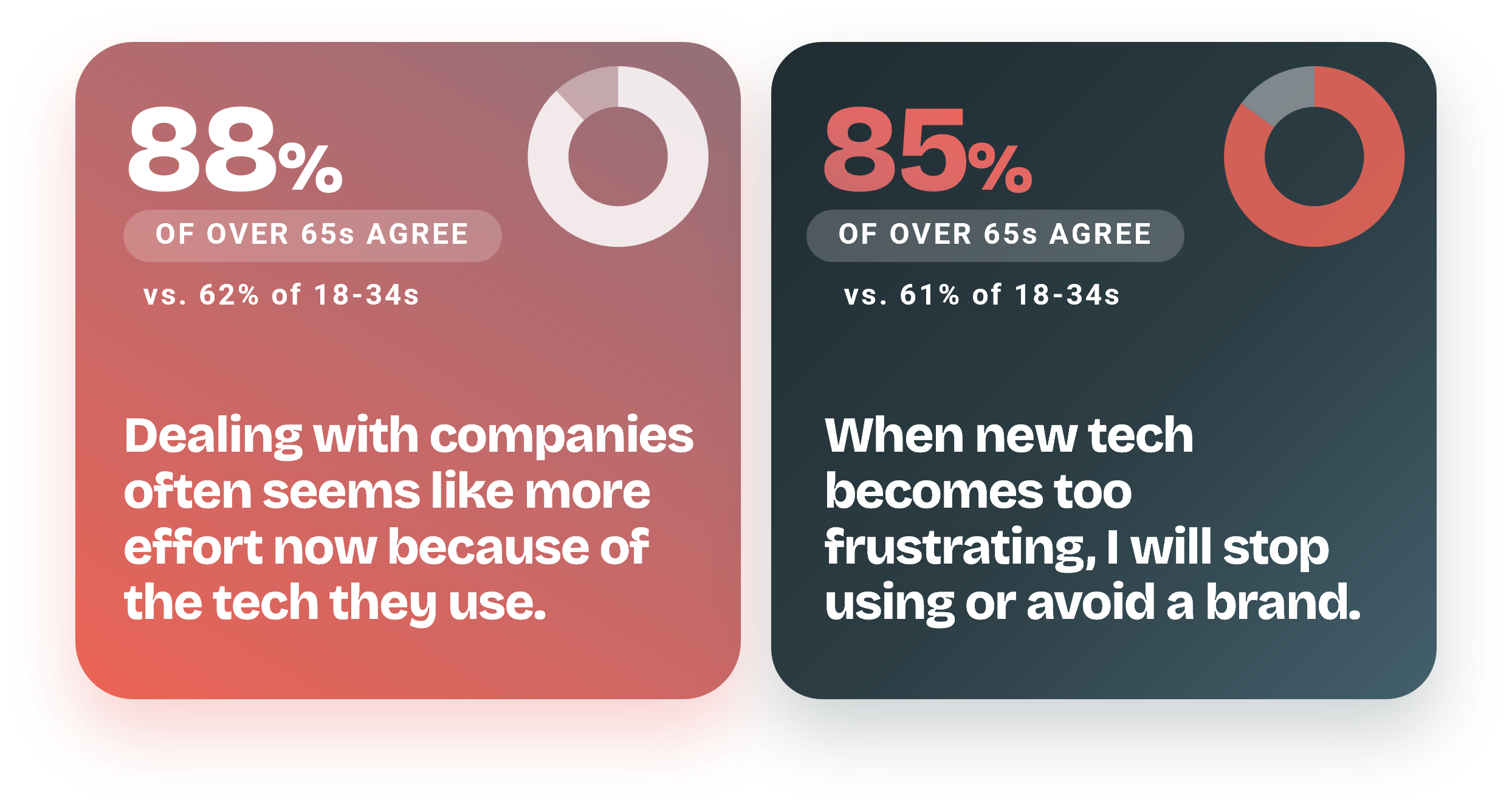
Almost nine in ten people in this older age group told us that dealing with companies can feel like more effort because of the way brands are using tech. This impacts their brand choices, with the vast majority agreeing that when tech becomes too frustrating they will stop using or avoid a brand.

“If I cannot speak with a human when I need help then I avoid that company. I am elderly and find reliance on tech challenging.”
Research participant, 76
Below, we look at where that extra friction appears for older people across the signs of Digital Decay, and why removing value from the experience can end up removing customers too.
1. Account fatigue
Buying something simple can now mean creating yet another account, inventing another password, remembering another login and sometimes completing additional verification before you can get on with what you came to do. For older people, that accumulation of digital admin can become a barrier in itself.

85% of people aged 65+ agree there are too many different accounts and apps for everyday life, compared with 70% of 18–34s.
“I am having a REALLY frustrating time trying to log on to my Ocado account... I have spent so long trying it is making me miserable and ill. I am 79, so I am returning to Sainsbury’s website!”
Research participant, 79
2. Customer effort increasing, not decreasing
Self-service was supposed to make everyday tasks quicker. Instead, customers can find themselves scanning their own shopping, ordering through kiosks, troubleshooting machines, completing forms or carrying out tasks that would once have been handled by a member of staff. Older people are particularly likely to feel that some of this effort has simply been transferred onto them.

75% of people aged 65+ feel they are being asked to do tasks staff would previously have done, compared with 57% of 18–34s.
“Being forced to use self-service tills in supermarkets, and having to keep calling the assistant to sort out problems, when a manned till would be so much quicker and easier if only they had them.”
Research participant, 67
3. AI chatbots and access to human help
The real test of customer service often comes when something has gone wrong. Yet that is increasingly the point at which customers encounter automated menus, chatbot loops or support systems that make it difficult to reach a person. What might be an irritation for one customer can become a dead end for another.

84% of people aged 65+ say they would avoid a brand that makes it difficult to speak to a real person, compared with 64% of 18–34s.
“You get fed through a list of questions that may not apply... and go round in circles. It is very frustrating when you know you could make a person understand in a few seconds.”
Research participant, 66
4. Communication overload
A single purchase can now generate a surprisingly long trail of contact: order confirmations, dispatch updates, delivery notifications, promotional emails, reminders, feedback requests and invitations to review the experience. Useful information that was once easy to find can quickly get mixed up with selling, and stopping the flow can create another task in itself.

77% of people aged 65+ agree there are too many emails and notifications when making purchases or dealing with brands, compared with 66% of 18–34s.
“I get fed up of repeatedly being asked to leave a review even for the simplest of purchases or repeat purchases.”
Research participant, 70
5. Apps becoming gateways for simple tasks
Parking the car, ordering food, using a loyalty card or accessing a ticket increasingly comes with the same instruction: download the app. For people who do not use a smartphone confidently, do not want another app or simply do not have the right device with them, a task that once took seconds can suddenly become difficult or impossible.

56% of people aged 65+ have been put off by digital-only requirements in everyday life, compared with 38% of 18–34s.
“I avoid restaurants where you have to order via an app from your table. How stupid is that!”
Research participant, 79
6. Squeezing customers for more
Digital experiences are also asking audiences and customers for more in return. A service may come with a subscription where there used to be a one-off purchase, advertising can appear inside something already paid for, prices can change at checkout, and access to a website can involve repeated requests for cookies, tracking and personal data. A lack of transparency and clarity can make the value exchange feel increasingly one-sided and undermine trust.

63% of people aged 65+ have been put off by at least one form of ‘digital squeeze’.
“Finding out that you have a subscription on the basis of one purchase because the mention of the repeat deliveries was nowhere near the actual payment details.”
Research participant, 79
Digital itself is not the problem. It’s what brands take away when it’s introduced that matters most.
The strongest message from older people is not that they want brands to stop using tech. It is that digital works best when it adds something without unnecessarily removing what was already working well and valued. That might mean keeping customer service available when an issue becomes complicated, allowing someone to park or pay without an app, retaining a staffed option alongside self-service, or simply making sure there is another route when digital does not suit the situation, becomes too difficult or requires a device someone does not have to hand. Clarity and transparency, key to earning trust, also matter more to older customers.
Those choices have commercial consequences. Older people are already switching retailers because they cannot log in, avoiding businesses that require apps, dropping services where support is only available via chatbot and choosing not to visit places where everyday tasks have become digital-only.
“My internet provider can only be accessed by bot... I shall definitely move to a more user-friendly company.”
Research participant, 65+
Older people are not one homogeneous group, and many are confident digital users. What the research shows is that they are more likely to notice when digital transformation takes something away from the experience without giving enough back. For brands, the question is not simply “Can customers use our digital service?” but “What did customers value before, and what will happen if we remove it?”
Digital can make experiences faster, easier and better. But when it removes choice, human connection or straightforward ways of getting things done, some customers will not adapt around the brand’s digital experience. They will choose another brand that better aligns with what they valued in the first place.
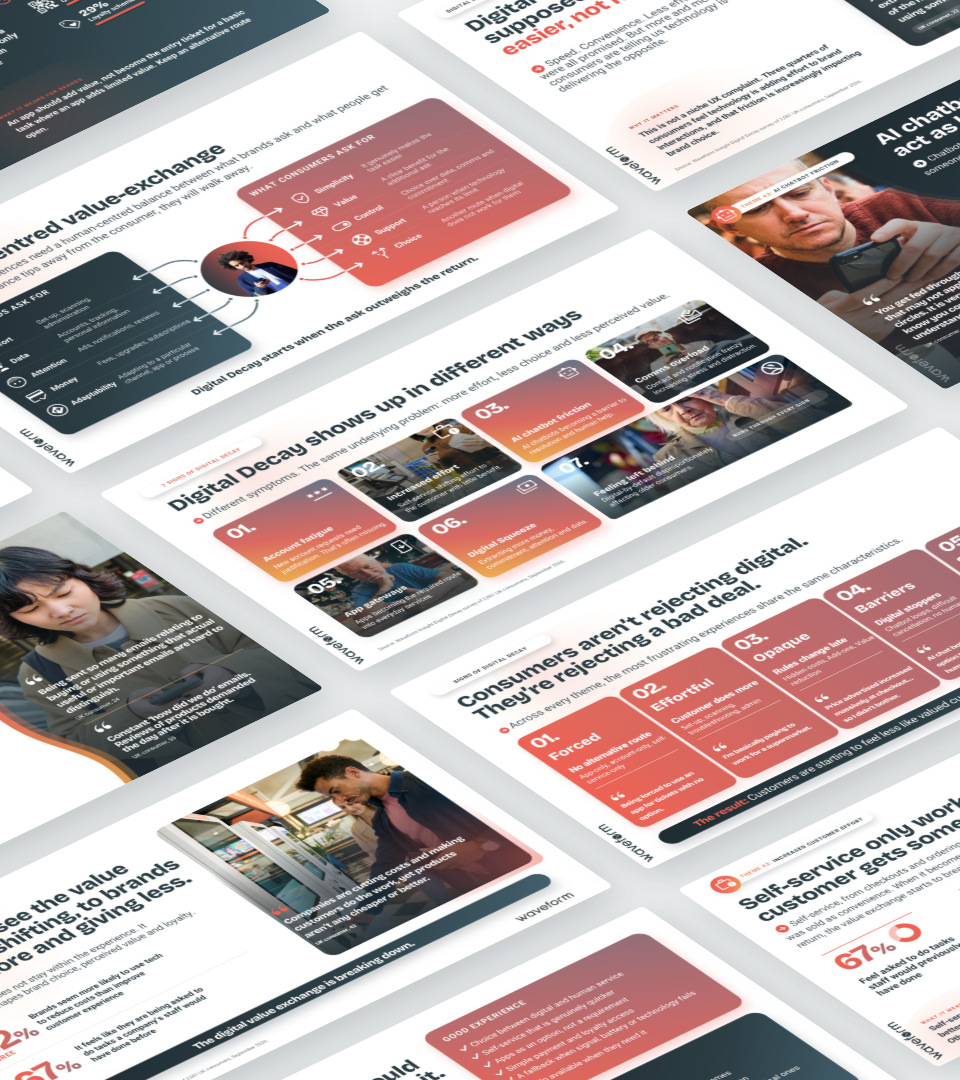
Our full Digital Decay research explores these signs in more detail across all age groups, including the underlying attitudes and behaviours, differences between audiences and the implications for brands designing digital and multi-channel experiences.
If you work for a brand or organisation and would like to see the full findings, please get in touch via the form below to request the full report. We’ll also be sharing more findings on our LinkedIn page and in future blog posts here.