
The Ideal Customer Profile has quietly become one of the most relied-on tools in B2B sales and marketing. At its simplest, an ICP describes the organisation most likely to buy, stay and generate value: size, sector, spend, number of sites, the roles that sign things off. As account-based approaches have taken hold and teams have got more disciplined about where they spend their time, the ICP has earned its place as the filter that keeps everyone aimed at the right kind of business.
And as a filter, ICPs are genuinely useful at providing focus on your target audience. But most ICPs stop at who, and skip the question that actually decides whether you win: why would this buyer move, and what would make them move to you? That's the gap where deals are won and lost, and it's why so many ICPs, for all their prominence, still aren't truly actionable for the teams that have to go and sell.
We recently helped a client in the B2B energy space close exactly that gap. Their ICPs were solid but two-dimensional, useful for filtering but not for selling. The work took them from flat profiles to rich, empathetic personas (at the organisation and individual influencer level) the commercial team could actually use, and the gap they had is one most B2B businesses share.
Who is only half the picture
A firmographic ICP treats every business that fits the profile as equally winnable. They almost never are. Two companies of the same size and sector can be miles apart on whether they're even in the market, what they're trying to fix, and what would tip them into switching to one brand over another.
To close that gap you have to understand what's actually driving the buyer: the needs they're trying to meet and the motivations behind them. Not just "a mid-sized firm in this sector," but a person under pressure to solve something, often with multiple stakeholders, weighing up whether change is worth the hassle. Get to that, and your outreach can speak to what the buyer is already experiencing rather than describing your product on your own terms.
Needs and motivations, made actionable: Jobs-to-be-Done
Understanding needs is one thing. Doing something useful with that understanding is another. This is where the Jobs-to-be-Done framework comes in.
The idea is simple: people don't really buy products, they "hire" them to get a job done. So instead of asking "who is this buyer?", you ask "what progress are they trying to make, and what have they hired a supplier to achieve?" It turns a fuzzy sense of need into something concrete you can build a conversation around.
Crucially, every buyer is juggling three kinds of job at once:
Functional jobs are the practical tasks they need done: lock in a predictable price, keep supply running, get the billing right.
Emotional jobs are how they want to feel: confident the decision won't backfire, reassured they're not being taken advantage of, free of a nagging worry.
Social jobs are how they want to be seen: able to defend the choice to a board, seen to run a tight ship, credible in front of colleagues and customers.
In B2B this matters more, not less. Purchases are considered, multi-stakeholder and rarely impulsive, and the emotional and social jobs, the career risk of backing the wrong supplier, the need to justify a decision internally, are routinely underplayed. They're often what actually swings it.
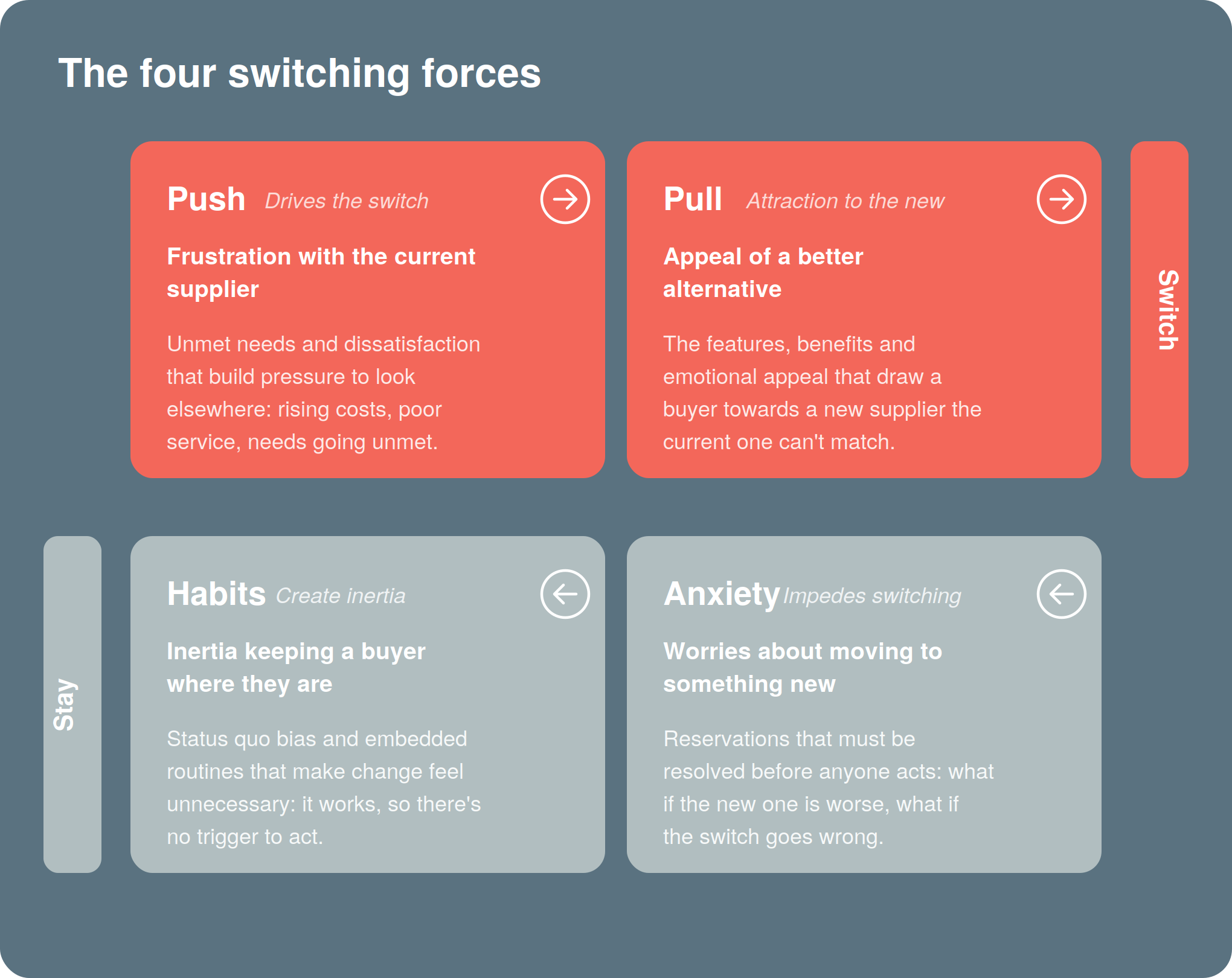
Pairing this with Switching Forces model makes it sharper still. Every decision is shaped by four forces: the push of present frustration, the pull of a better alternative, the anxiety about moving, and the habit of staying put. Win the push and pull, ease the anxiety, break the habit, and you understand not just who the buyer is but exactly what has to be true for them to act.
One ICP, or several?
The second shift is realising that most businesses don't have a single ICP. They have several, with different jobs, different triggers and different value.
Grouping buyers by the job they're hiring you to do, rather than by firmographics alone, is what makes an ICP actionable. It lets you put effort where it's worth most, lead each conversation with the job that segment cares about, and spot the underserved group competitors are ignoring. The same offer can be sold three different ways to three segments, and a needs-based view tells you which way, for whom.
Why this takes both qualitative and quantitative research
You can't get to this level of understanding from a CRM export or seeing which companies your competitors have picked up. It comes from going to the buyers themselves, and it needs both qualitative and quantitative research, because each does a job the other can't.
Quantitative research gives you scale and confidence. A survey of the people who fit your ICP tells you how common a need is, how segments differ, and which triggers and priorities actually move the numbers. It stops a persona being built on a handful of loud opinions.
Qualitative research gives you the texture. In-depth interviews and video Q&As surface what a survey can't: the language buyers use, the frustration behind a metric, the trade-offs they weigh, the moment something tips from "fine" to "I need to look at this." This is where empathy comes from, and empathy is what makes a persona usable.
Used together, the two move you past firmographics to the operating reality behind each profile: what triggers a review, who's really in the room, what keeps a buyer up at night, and what a win looks like for them personally as well as commercially. For SmartestEnergy, that combination is what turned a flat profile into a buyer the commercial team could recognise.
From description to deliverable
The output of work like this isn't a tidier description. It's a set of prioritised, needs-based personas, each mapped against its jobs and switching forces, that tells the commercial team who to focus on, when those buyers are likely to be in market, and how to open a conversation in the buyer's language rather than the supplier's.
In other words, the ICP stops being a document that lives in a drawer and becomes something the sales and marketing teams can pick up and work with to better reach and convert prospects: knowing what a buyer type cares about most before a call, who's most likely to be ready when prioritising outreach, and what the buyer is trying to solve when opening a conversation.
The takeaway
A firmographic ICP tells you where to aim. Understanding needs and motivations, made actionable through Jobs-to-be-Done and sharpened by segmentation, tells you why a buyer would switch to you (or not) and what to say and deliver to convert them and keep them.
That's the difference between a profile and a prospect. And it's how a well-built ICP earns its keep, by focusing effort where the value and the fit are highest.